The advantages of 5-axis CNC machining
The advantages of 5-axis CNC machining
Five-axis CNC machining is a type of computer-controlled manufacturing where the cutting tool moves along three linear axes (X, Y, Z) and two rotational axes to shape a part. This allows the tool to reach multiple faces and angles in one go. Standard CNC machines typically operate along just three axes, which means the tool can only cut from above or the sides unless the part is manually repositioned. With 5-axis, the tool or part rotates instead—saving time, improving accuracy, and making it easier to machine complex or curved features.
How 5-axis differs from 3- and 4-axis machining?
Five-axis CNC machining includes two rotational axes, allowing the tool or part to tilt and rotate so that multiple sides can be machined in a single setup—without needing to stop and re-fixture. Compared to 3-axis machines, which move only in straight lines along the X, Y, and Z axes, and 4-axis machines, which add a single rotation, 5-axis offers a second rotational axis that dramatically increases flexibility. Depending on the machine configuration, 5-axis machining can rotate either the part, the tool, or both, giving you access to hard-to-reach areas in one setup. This matters a lot when you’re working with detailed geometries, sharp corners, or deep cavities. Imagine carving a sculpture. With 3-axis, you're chiseling one side at a time. With 5-axis, you can rotate both the sculpture and your chisel as you go—no need to stop and reposition.
When to use 5-axis over 3- or 4-axis ?
- Your part has awkward angles or deep pockets that are hard to reach.
- You need fewer setups to maintain tight tolerances.
- The surface finish has to be perfect and you want smoother passes.
-
You’re prototyping something complicated or producing parts with lots of detail.
How 5-axis CNC machining works?
Five-axis CNC machines work by moving the cutting tool or the part along five different axes—three linear (X, Y, Z) and two rotational. The rotational axes are chosen from A, B, and C, which represent rotation around the X, Y, and Z axes, respectively. A 5-axis machine uses two of the three possible rotational movements, depending on its configuration. Some machines rotate the part itself, others move the tool head, and some do both. There are also 6-axis machines that add a third rotational axis, enabling movement around all three linear axes, but they’re still relatively niche. The 5-axis setup already lets the tool tilt and pivot into hard-to-reach areas, without needing to stop and flip the part. That’s often all you need, even for contoured shapes, undercuts, or complex geometry.
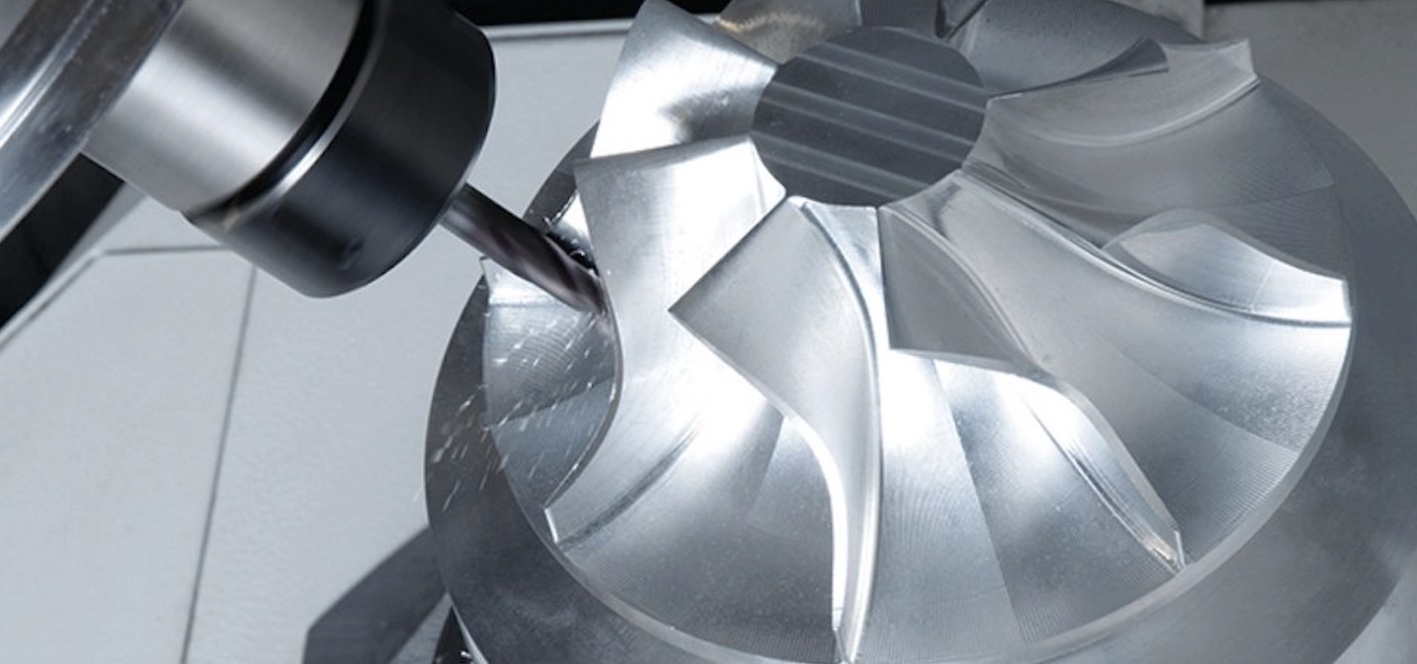
Regardless of how a 5-axis machine is configured, the result is the same: the tool can approach the part from multiple directions in a single machining pass. This flexibility is what makes 5-axis machining especially powerful for complex surfaces and features that would otherwise require multiple setups. There are two common styles of operation:
- Indexed (3+2): The tool or part rotates to a fixed angle, then traditional 3-axis machining happens from there.
- Continuous (simultaneous 5-axis): The tool keeps moving in all five directions as it machines. This is what you’d use for smooth, contoured surfaces.
-
Advantages of 5-axis CNC machining
There’s a lot to like about this dynamic manufacturing setup. Here are some of the reasons engineers choose 5-axis machining.
- Fewer setups: Machine all sides of a part without stopping to reposition.
- Better surface finish: Tool stays at optimal angles for a cleaner cut.
- Tighter tolerances: Less movement means higher accuracy.
- Supports complex shapes: Get curved, angled, or organic features.
- Simpler assemblies: Design parts as one solid piece instead of several glued or bolted together.
-
Longer tool life: Smart angles reduce stress and heat on the cutting tool.
Limitations of 5-axis CNC machining
As powerful as 5-axis machines are, they’re not always the right tool for the job. Here’s what to keep in mind.
- It may not be cheap: The machines are more expensive and need specialized operators.
-
Programming is trickier: More axes mean more complex toolpaths.
Too much machine for simple parts: If you’re just cutting a cube, 5-axis might be overkill. -
Quality checks matter: Extra movement can result in more simulation or inspection work.
Design tips for 5-axis CNC machining ?
Designing for 5-axis isn't just about avoiding mistakes—it's about taking advantage of everything this type of machine can do.
- Make sure features are reachable from multiple angles. Position holes, slots, or pockets in locations that don't require extreme tilt angles. Even 5-axis machines have limits.
- Think about how the part will be held in place as it rotates—5-axis machines still need stable, accessible fixturing to get the angles right.
- Consolidate parts when it makes sense. With 5-axis access, you can often combine multiple components into a single, more complex geometry.
If you have any project, please feel free to contact: inquiry@abcrpaid.com.
Search
Recent Post


Other New Articles